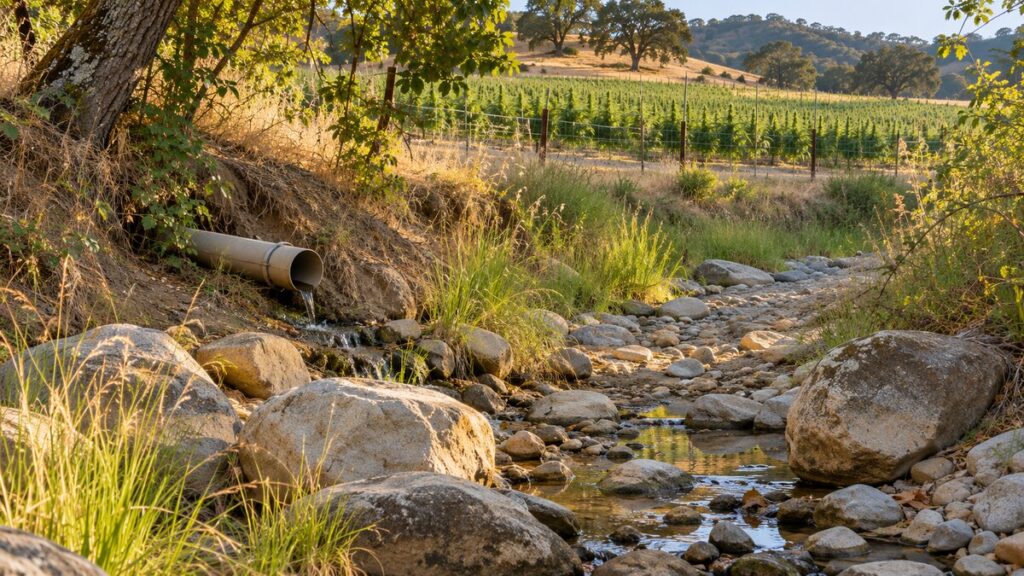
Look at an irrigation record from August and you can see water reaching a crop. You cannot necessarily see a pump taking water out of a stream that day. The irrigation water might have come from a tank filled during winter rain. Another farm might draw directly during low summer flow. Add the water used by the two crops over a year and the difference could vanish from the ledger. To the creek below them, it may be the most important difference of all.
Give the water two dates
In parts of Northern California, the months when outdoor crops need irrigation overlap with a long dry season. Winter rainfall can produce relatively high flows, while summer leaves some small channels with little water moving between pools. A withdrawal of a given volume represents a larger fraction of the flow when the stream is low. The volume used by a plant and the fraction of the stream diverted are thus quite different measurements.
A study of water storage and irrigation practices on cannabis farms examined when growers obtained water as well as when they applied it. The researchers found that storage and the type of water source influenced extraction patterns. In general, the farms examined lacked sufficient storage to cover their summer needs entirely without additional withdrawals. The existence of a tank, in other words, did not establish that a farm’s irrigation had been completely separated from the dry season.
A tank has capacity and contents
Take an imaginary tank large enough to hold a month’s irrigation water. It might start summer full, half full or empty. Two farms reporting the same storage capacity can therefore have different demands on nearby water sources in July. Conversely, two farms with the same annual diversion can distribute it quite differently across seasons. A useful account needs the timing of filling and emptying, rather than an inventory of tanks alone.
There is a biological story behind the bookkeeping. In a small stream, a reduction in flow may change how pools connect and how much habitat remains available. An assessment of four northwestern California watersheds examined potential impacts of cultivation-related diversions against local streamflow. Estimates depend on assumptions about the farms and water sources. They describe potential pressure on a watershed more directly than they establish the effect of any single withdrawal on a particular fish.
Groundwater gives the calendar another wrinkle
A well looks as though it bypasses the creek. Yet groundwater and surface water can be connected. Pumping can reduce groundwater discharge that would otherwise reach a stream or draw water away from the channel over time. The US Geological Survey’s explanation of streamflow depletion shows why the timing and magnitude of these effects depend on the subsurface setting, including the relationship between a well and the stream.
That makes a seasonal ledger more demanding. On the day someone diverts surface water, the withdrawal and its immediate effect can be closely linked. The hydrological consequences of groundwater pumping may be distributed over a longer period. Deciding how a particular well affects a particular creek requires local evidence. A statewide count of wells cannot supply the missing geology.
Which comparison does the creek need?
California’s surface-water diversion policy for cannabis explicitly distinguishes seasons. Researchers can also place cultivation alongside other uses, as a watershed comparison of residential and agricultural demand illustrates. A crop’s share of annual regional water consumption and its share of a small tributary’s dry-season flow have different denominators. One can be small while the other is consequential.
When someone quotes a water figure for a cannabis farm, try placing it on a map and giving it two dates. Where was the source? When did the farm withdraw the water? When did the crop receive it? Those details turn a volume in a spreadsheet into something a person standing beside a stream in August might actually recognize.