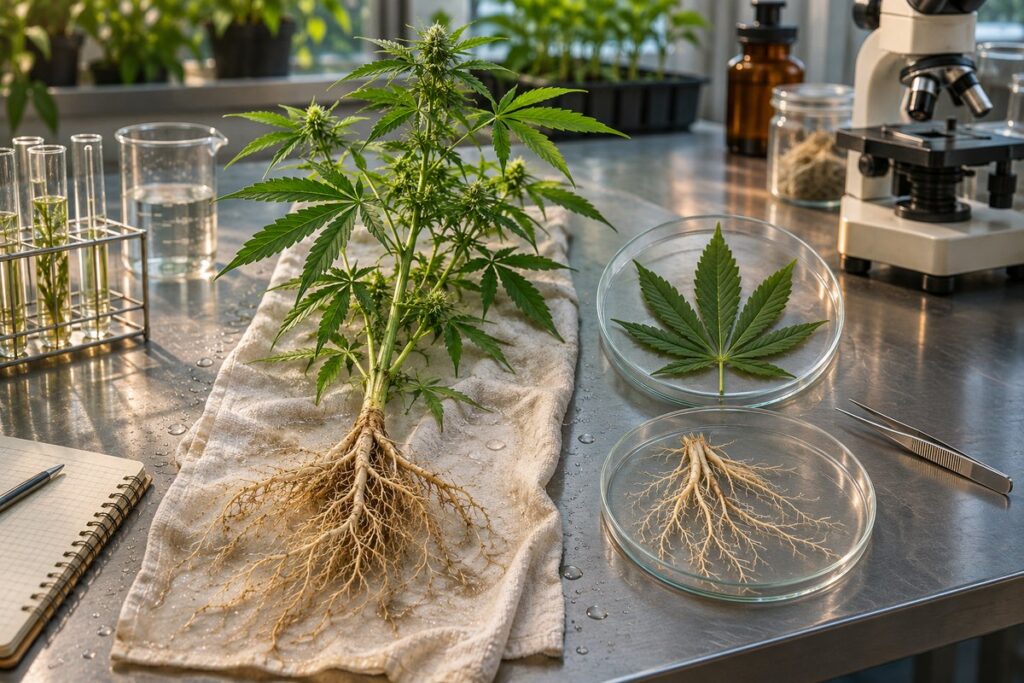
The cutting blade divides a hemp plant in almost exactly the wrong place for anyone hoping to harvest cadmium. Stems fall to the mower while roots stay underground. In some experiments those roots held the highest concentration of the metal anywhere in the plant. An apparently successful crop can therefore produce two quite different results: a root system full of cadmium and a wagon carrying very little of it. Which result matters depends on what the landowner hoped the plants would do.
Cadmium is an element. A plant can take it up, bind it or move it from one tissue to another. It cannot break it down into harmless pieces in the way some soil microbes can break down an organic pollutant. As the US Environmental Protection Agency’s guide to phytoremediation explains, extracting a contaminant and stabilizing it on site are distinct aims. A healthy-looking stand of plants might be doing something valuable without removing much metal at all.
Taking the root and shoot apart
In a hydroponic experiment with hemp, Amanda Marabesi and colleagues exposed plants to cadmium in nutrient solution and examined tissue from different parts of the plant. Under those conditions, roots accumulated considerably higher concentrations than leaves. At higher exposure, the researchers also observed changes in the abundance of RNA messages for several metal transporters in the roots.
An RNA measurement supplies a clue about how the plant responds. It does not tell a farmer how many grams of cadmium rode out of the field on a trailer. A transporter may help move metal across a cell membrane within the root, for example. To establish the quantity that reaches the shoot, someone still has to measure the tissues themselves and weigh the material produced. Growth matters here, too. An exposure that leaves a plant severely stunted can make a high tissue concentration much less impressive at harvest.
The calculation missing from a concentration
Imagine an illustrative harvest with a hundred kilograms of dry roots containing ten milligrams of cadmium per kilogram. That amounts to one gram of cadmium below ground. Suppose the same plants produce a thousand kilograms of dry shoots containing one milligram per kilogram. That also works out to one gram. A tenfold difference in concentration has produced an even split in the metal because the shoot material weighs ten times as much.
If all those shoots leave the site, the harvest exports half of the two grams counted in the plants. It would be quite a leap to report that half the field’s cadmium had been removed. The calculation never included the much larger quantity that may still be present in the soil. It also assumed that every leaf included in the dry weight made it onto the trailer. A crop harvested for stems alone could give a different result.
Bringing the field back into the experiment
Nutrient solution gives researchers comparatively tight control over root exposure. In soil, the accessible fraction of cadmium depends on local chemistry, including how strongly it is held by soil particles. A field study of several metals in contaminated soil found substantial retention of metals in roots and identified both environment and variety as important to the outcome. A review of industrial hemp for contaminated soils places such experiments in the wider evidence on possible cleanup uses.
The last entry in the account comes after harvest. Cadmium exported in biomass has changed location. Its destination and handling are therefore part of any evaluation of the project. For someone reading a field report, three figures make the claim much easier to judge: the concentration in each harvested part, the dry yield of that part and the estimated stock of metal in the soil volume under consideration. A root left in the ground belongs in the site inventory, even if a small piece of it has already made the trip to the laboratory.