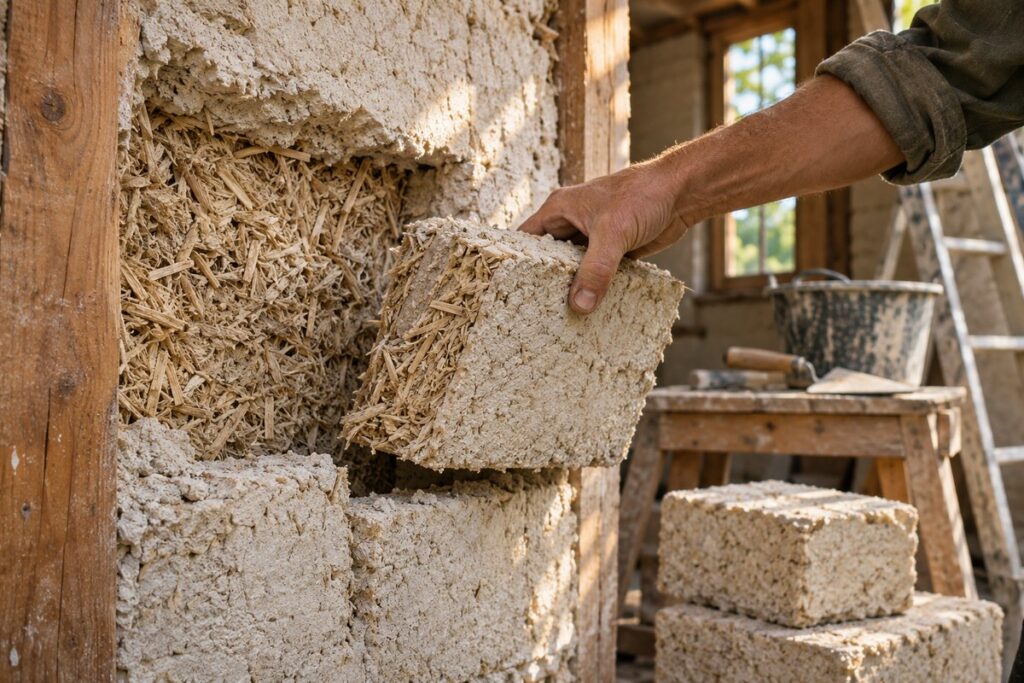
On the day a hemp-lime wall is completed, some of the carbon once floating in the atmosphere is sitting inside a building. It arrived there in the woody inner part of the hemp stalk, known as shiv. A builder can point to it. The more difficult question is what date to put beside it in a greenhouse gas account. Opening day, the last day of the building’s life and the end of a second use for its materials can each tell a different story.
A life-cycle study of hemp-lime walls in Serbia makes the importance of those dates unusually clear. The researchers modeled a range of assumptions about uptake, transport, construction waste and eventual release of carbon from the shiv. Their optimistic scenario produced a negative greenhouse gas balance over the modeled life cycle. Their average and pessimistic scenarios produced positive balances. The study did not discover three different laws of chemistry. It asked what would happen to materials following different paths.
A growing plant and a hardening binder
Hemp captures atmospheric carbon dioxide during growth and incorporates some of its carbon into the stalk. Once the shiv is mixed into a wall, the material can keep this carbon out of circulation for as long as the organic matter remains intact. The wall also contains a mineral binder with a different history. Making and transporting that binder generates emissions that belong in an account of the finished material.
Certain binder constituents can then react with carbon dioxide in a process called carbonation. Carbon ends up in mineral carbonates. The amount taken up depends on the binder and the extent of the reaction. A model of carbonation in hempcrete treats this as a chemical process with limits. It would be an error to count the carbon in a stalk and then credit the binder with taking up that same carbon a second time.
Two futures for the same wall
Imagine two otherwise identical walls taken down in the same year. In one case, material containing the shiv is recovered intact enough to serve again. As long as that organic fraction persists, its carbon remains stored beyond the first building’s life. The next use may require transport or processing, which adds emissions of its own. The accounting boundary matters here. Two projects cannot each claim the full original uptake as their independent achievement.
In the other case, assume that the shiv degrades after demolition and some of its carbon returns to the atmosphere. The balance then has to include the modeled release. Exactly how much is released, in which form and when depends on the disposal conditions. Demolition itself tells us when the wall ceased to exist as a wall. It does not tell us that every carbon atom in it returned to the air that afternoon.
Those two futures are illustrative. In the Serbian assessment the end-of-life assumption changed alongside other choices, including waste and transport. The change in the sign of the total cannot all be attributed to a single trip to a disposal site.
What happens before demolition counts too
The years in between have a bill of their own. A follow-up study of finishes and renewal schedules examined the implications of maintaining different finished walls. Two walls with the same hemp core could require different amounts of material or work over their lives. A US life-cycle assessment offers another reason to check where a wall was built before borrowing its carbon total.
So how long does the carbon stay? For the carbon in the stalk, the physical answer follows the shiv through service, recovery and eventual degradation. For the number on a building assessment, it follows the years and processes the analyst included. A report that specifies both can distinguish carbon still present at demolition from carbon expected to remain in storage decades afterward.